
Brief · October 2026 · EmpowerK12
Shaping AI in DC Schools Together
A Capital AI Education Collective brief on what the evidence shows about AI in schools, what it does not yet illuminate, and why DC, with its record in tutoring, reading and math, can solve this together.
In short
- Most students use AI without adult guidance. RAND finds that 63 percent of US high school students used AI for homework in December 2025, up 14 points in seven months.
- Strong evidence is rare. Stanford's 2026 review of more than 800 papers finds 20 with strong causal evidence, and none assesses a student tool in a US K-12 school.
- AI can help beside a skilled teacher and cost learning alone. In a Turkish experiment, a general chatbot raised class grades 48 percent, and its users scored 17 percent lower on the exam.
- DC's own data holds a warning sign. For economically disadvantaged students, the gap between graduating and SAT readiness grew 18 points since 2018, and 14 points for all students.
- DC has done this before. The Education Scorecard ranks DC first among states for growth in both math and reading from 2022 to 2025. The Collective now seeks a DC AI Education Fund.
AI is already in the classroom
ChatGPT is nearly four years old, and AI is quickly becoming part of growing up. In Britebound's survey of 3,000 students in grades 7 to 12, 83 percent use AI. RAND finds that 63 percent of US high school students used AI for homework in December 2025, up 14 points in seven months. The students we have worked hardest to lift post-pandemic are the most exposed. Pew Research Center found at the beginning of last school year that 20 percent of teens in households earning under $30,000 do all or most of their schoolwork with chatbots. In households earning $75,000 or more, 7 percent do.
The gap is guidance. Among teens who use AI for schoolwork, 39 percent tell Common Sense Media they miss out on learning when they use it to complete assignments. In the same survey, only three in ten teens say a teacher has ever discussed how to use AI safely. Gallup and the Walton Family Foundation find that 68 percent of US public school teachers had no school or district AI training in 2024-25. Where most teachers encourage AI, 61 percent of teens in Britebound's survey rate themselves highly AI-ready. Where AI is strictly forbidden, 9 percent do. A survey cannot show cause, and self-rated readiness does not measure learning. The surveys indicate that most students lack an adult who shows them how to learn with AI.
These figures are national. We find no public measure of how DC students use AI. The moment, page 4 (PDF).
A warning sign in DC
For economically disadvantaged students, OSSE reports that the four-year graduation rate rose from 59 percent in 2018 to 73 percent in 2025. The share who meet the SAT college and career ready benchmark fell from 8 to 4 percent. For all students, the graduation rate rose from 68 to 79 percent, and the SAT share fell from 20 to 16 percent. The gap between diplomas and readiness widened in the pandemic and grew furthest apart in 2024-25 as AI use climbed.
This is a concerning association. Homework, grades, and credits are signals that middle and high school educators, students, and families rely on, so the Collective aims to gather evidence and monitor early signals of AI misuse. In a working paper, researchers at Stockholm University and the University of Hong Kong follow 26,811 students in one county in central China, finding that after students adopt AI on their own their homework scores rise 18 percent and monthly exam scores fall 20 percent. Grades up, understanding down. That is a risk, and one reason the Collective is acting.
The working paper is not yet peer reviewed. We need better local data to understand how AI use links to high school success measures. The graduation and SAT chart, page 5 (PDF).
What the research says
What Stanford's review finds
Stanford's 2026 review of more than 800 papers finds some promise for students with disabilities, a clear pattern of concerning student outcomes without adult support, and almost no strong causal evidence from US K-12 classrooms. Twenty studies offer strong causal evidence. Of these, 14 study tools that students use and 8 study tools for educators, and none of the 14 takes place in a US K-12 school.
Strong evidence is rare.
Twenty of more than 800 papers offer strong causal evidence, and none assess a student tool in a US K-12 school.
Performance with the tool is not learning.
Students do better while using it, and the gain can fade or reverse without it.
In a randomized experiment with nearly 1,000 high school math students in Turkey, a general chatbot raises class grades 48 percent. Without AI on the exam, students who used AI score 17 percent lower than students who never had AI.
AI lowers student effort and productive struggle at the expense of critical thinking.
General chatbots tend to lower exam scores, while some tutoring chatbots show promise.
Design matters.
Tutoring tools that give hints and step-by-step reasoning show more promise than general chatbots.
In the same experiment, students whose chatbot gave hints and withheld answers kept pace with their peers.
AI can save teachers' time.
Teachers in England with a chatbot and a guide spend about 30 percent less time preparing lessons, with no detectable loss of quality.
AI can scale expertise.
In a US trial with 900 tutors, students whose tutors use an AI coach are 4 percentage points more likely to master the topic, and 9 points when the tutor is lower rated.
The studies our students need do not exist yet. DC has classrooms where those studies can begin. What the research says, page 6 (PDF).
DC has schools and educators tackling this moment
Some DC schools already use AI to support teachers, tutors, and students in smart ways. At the Summit, CitySchools Collaborative presents Sophia, an AI coach for math tutors piloted at Meridian Public Charter School, the kind of tool the research favors. Friendship Public Charter School uses AI to pair its document-based questions with teacher guidance and student scaffolds. Washington Leadership Academy, at work on AI since the week ChatGPT launched, takes a human-first approach to AI for multilingual learners and students with disabilities. Across the city, DC Public Schools is implementing Yourway Learning, Kingsman Academy built a custom lesson-planning app on Playlab, and a first cohort of the DC AI Innovation Fellowship is underway.
Citywide, interest in AI runs far ahead of use among the 39 of DC's 69 LEAs that responded to OSSE's February 2026 survey. Of those LEAs, 45 percent have written guidance for staff use of AI and 34 percent have written guidance for student use. A formal review process for AI tools exists at 26 percent, and 41 percent have not invested in AI tools. Of those LEAs, 46 percent call data privacy and security a significant or prohibitive challenge, and 35 percent express uncertainty about instructional value. Asked what would help most, LEAs ranked model policy highest and training for educators third. OSSE released model guidance for LEAs this summer, and the Collective has a goal to expose and train all core staff in schools and districts on AI literacy by summer 2028.
Tools are named to describe the work. A listing is not an endorsement. What DC is learning, page 7 (PDF) and more bright spots across DC, page 15 (PDF).
Lessons from five places to give DC a jumpstart
The Collective is learning from five states and cities that have made valuable progress in finding answers to AI in schools. Each place offers a practice DC can borrow.
| Place | What it built | What DC can borrow |
|---|---|---|
| New Orleans | The New Orleans AI Education Fund, a five-year effort that ends in 2029. Leadership cohorts come first, then implementation grants. First-cohort operators serve 60 percent of the city's public school | Start from need, invest in implementation, require sharing, and set an end date. |
| Tennessee | SCORE's AI Innovation Fund backs nine 12-month, educator-led pilots of up to $50,000, chosen from 75 applicants. Each will report results and build shared practice. | Small important bets, led by educators, that report within a year. |
| Utah | The first full-time state position for AI in schools, training that reaches more than 7,000 teachers (the early goal was 1,500), and privacy terms that districts can adopt with one signature. | How to train and support districts at scale. Settle privacy terms once and share them. |
| Texas | A 10-month collaborative from Educate Texas for more than 125 district leaders and education experts. School systems work through a structured problem of practice and report what changes. | Support structures for system leaders, a model the Collective has already launched. |
| Delaware | A state AI Assurance Lab that reviews tools for privacy, security, accessibility, and equity, tests them in realistic classroom scenarios, and publishes the findings for every district and charter sch | One shared review, published for every school and LEA to use. |
How each effort started, from local funders to a state education agency, is on page 10 of the brief (PDF).
We know how to do this
DC worked together on tutoring, science of reading, and math, and the results show on a national scorecard and the DC state test. High-impact tutoring reached 12,610 students in 2025-26 through OSSE and CitySchools Collaborative grants and implementation support. Schools with science of reading literacy grants demonstrated proficiency gains 54% higher than other schools. The Capital Math Collective, a $20 million public-private partnership, brings DC Public Schools, EmpowerK12, and public charter schools together around evidence-based math with statistically significant growth. The independent Education Scorecard, from Harvard, Stanford, and Dartmouth, ranks DC first among states for growth in both math and reading from 2022 to 2025.
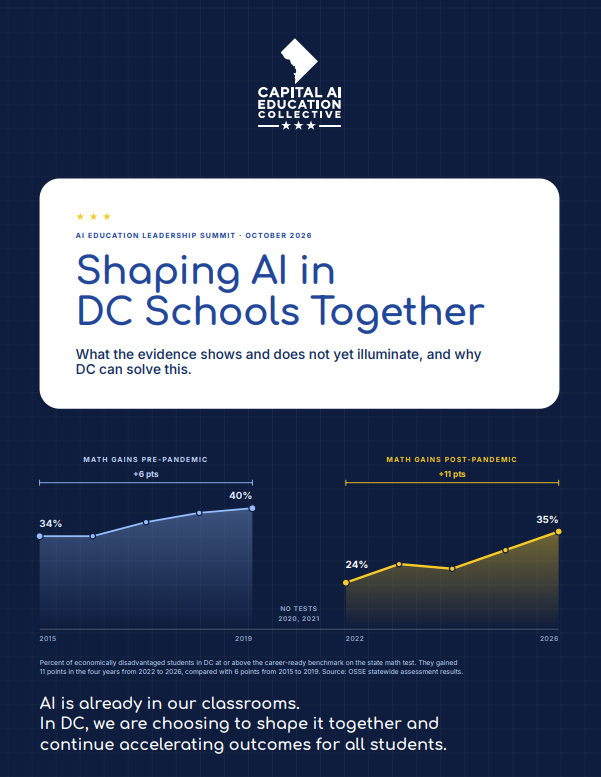
This year, reading passed 2019 proficiency levels for every group. Math is not yet back for three of the four groups but shows gains that are faster than before the pandemic. Economically disadvantaged students gained 11 points in math in the four years from 2022 to 2026, compared with 6 points from 2015 to 2019. Among economically disadvantaged students, the share at the lowest level in math fell 4.6 points in 2026, the largest one-year drop since 2015. A school's poverty rate now predicts its proficiency less than in any year since 2015.
Four habits run through DC's record. A commitment to sharing across both sectors. A problem identified in the data, then short-cycle evidence projects to improve outcomes. Honest results using robust methods, published. The students furthest behind come first. In one year, the median school in the Capital Math Collective's first grant cohort gained 3.6 percentage points in career-ready math proficiency, compared with 1.2 points for other DC schools. With the same partners and discipline in place, we are confident DC can solve any common challenges, including AI in schools.
DC's record, page 11 (PDF) and the cross-sector improvement playbook, page 12 (PDF).
What comes next
We apply the playbook to AI
EmpowerK12 and the DC Charter School Alliance formed the Capital AI Education Collective in partnership with DC Public Schools and DC government. Since June, four Strategic Councils brought 49 members and 8 co-conveners to one table. They ask for evidence and shared learning, shared policy and vetted tools, family voice before decisions are made, and training that continues through the year. Tutoring and the science of reading came with decades of research, and DC's job was to carry them out well. With AI, DC must build the evidence. Designing quality research analyses, training for every role, vetting every vendor, and elevating important lessons across the city are difficult to do one school at a time.
- Learn. The aim is evidence of AI's impact in DC classrooms. DC first needs a citywide picture of how students and teachers use AI. The Collective proposes citywide baseline AI use surveys this fall and short-cycle evidence projects led by educators in 2027. Schools will be asked to identify root causes in their own student data before choosing an AI evidence project. With support from EmpowerK12, pilots compare students, teachers, and schools who implement a solution with similar groups who do not, measuring key outcomes and publishing the result no matter what it shows. The most promising projects could earn a full study that meets the bar set by Stanford's review.
- Build. The aim is citywide support for model policies, best practices, and guardrails every school can use. The Collective's strategic councils ask for a single review of AI tools that the community can trust.
- Engage. Collective members engage the whole city, starting with additional opportunities to participate in learning cohorts, training in AI literacy, and Evidence Projects that support safe, effective, and responsible AI implementation in schools. Cohorts would serve every role, from executives and school leaders to teachers and nonprofit staff, over several months. Families and students help design and support the work.
- The DC AI Education Fund. The Collective seeks a DC AI Education Fund to pool support behind these three aims and accelerate the work under way. What it supports first, how long it runs, and what we ask of funders will reflect what we learn this fall at the Summit and through additional engagement, with a full fund launch in early 2027.
Questions the Collective brings to the Summit. What promising practices and ideas should we test first? What scale fits DC, several small bets or a couple of citywide efforts? What should a pooled fund make possible that single grants cannot? What comes next, page 13 (PDF).